Genetics in five minutes
Everything a moeba inherits follows a handful of rules, and each has a real counterpart in people and animals. One idea at a time: how it works in moebas, an example from today’s population, and the same idea in real DNA, with where moebas are simpler.
What the film says
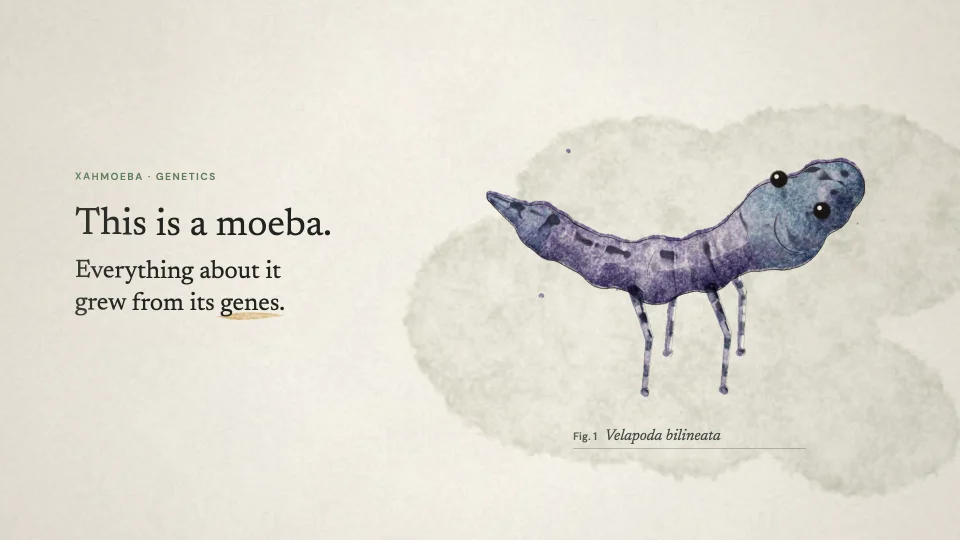
This is a moeba. Everything about it grew from its genes.
Two copies of every gene — one from each parent. You carry two copies of almost every gene, too.
Yours are written in DNA: about 3 billion letters in each set. A moeba’s whole genome is 32 bytes.
When the two copies differ, only one of them shows. The variants have a fixed order. The higher one shows. The other hides — still there, and can be passed on. Geneticists call these dominant and recessive.
Another moeba hides discoid, too. Each parent passes on one of its two copies, by chance. One child in four gets discoid twice, and shows a body neither parent has. In people, this is how two healthy carriers can have a child with cystic fibrosis.
Four hundred births of the same two parents, worked out with the species’ own rules. Chance lands near one in four.
Breed them, and the species changes. Now and then a copy changes at birth: a mutation. Some looks can only arrive this way. Whoever breeds one first, discovers it.
A small species, grown from its genome. Breed one, and see what it hides. Every genome is written on a public ledger.
Two copies of every gene
A moeba’s genome is 32 bytes holding 36 genes, and it has two copies of every one: one from each parent. Each parent passes on one of its own two copies, picked by the birth’s randomness, so a child gets half of each parent.
In real DNA
In people
You have 23 pairs of chromosomes, one of each pair from your mother and one from your father, so you carry two copies of almost every gene.
Compared with moebas
36 genes in 32 bytes. People have 20,000 to 25,000 genes, spread over about 3 billion letters of DNA in each set.
Which copy shows
When the two copies differ, one variant shows and the other hides. Which one is a fixed rule, not chance: every gene for a trait that is a kind has a ladder, and the variant higher on it shows. Higher is not better. The hidden variant is still there, and a child can get it.
- 1
polyponly by mutation
- 2
colonial (lobed)only by mutation
- 3
bifid (forked)only by mutation
- 4
elongatecopy 1shows
- 5
compact
- 6
discoidcopy 2carried
- 7
serpentine
Copy 1 says elongate and copy 2 says discoid. Elongate is higher on the ladder, so it shows; discoid is carried, and a child can still get it.
In real DNA
In people
Wet earwax shows over dry: it comes down to one gene, ABCC11. In rabbits, coat colour has a real ladder: full colour over chinchilla, over Himalayan, over albino. The shown variant is called dominant, the hidden one recessive.
Compared with moebas
In people both copies sometimes show at once: blood type AB shows both A and B. In a moeba, a trait that is a kind always shows one copy; a trait that is a number adds both (see 4).
Hidden in both parents: one child in four
A moeba that hides a variant carries it. If both parents carry the same hidden variant, each passes it on half the time, so about one child in four gets it on both copies and shows it: a look neither parent shows.
| discoid | elongate | |
|---|---|---|
| elongate | ||
| discoid |
28% of 400 births imagined with the Hooks’ rules showed discoid. The square says one in four; chance puts each real count near it.
In real DNA
In people
Cystic fibrosis and sickle cell disease are inherited this way. Two carriers, usually healthy themselves, have a 1 in 4 chance with each pregnancy of a child with the condition. Cystic fibrosis occurs in 1 in 2,500 to 3,500 white newborns; working back from that, roughly 1 in 25 to 30 white people carries one hidden copy.
Compared with moebas
The arithmetic is the same. In people it matters for health, which is why carrier screening and genetic counselling exist.
Numbers that blend
Some traits are a number rather than a kind: body size, limb length, base hue. There the two copies add up. A child takes one of each parent’s two, so it usually lands near the middle of its parents, though it can come out beyond either. At each birth, each copy also has a 2% chance of moving one step up or down.
Body size of 400 children imagined with the Hooks’ rules: 49% between their parents, 51% beyond either.
The first parent’s two copies are 4 and 10, the second’s 9 and 13, each on a scale from 0 to 15. A child adds one of each, which can come to 110, 144, 161 or 195. The small bars are births where a copy drifted a step.
In real DNA
In people
Height works like this: about 80% of the differences in height between people come from inherited variants, many of them each adding a little, and the rest from food and health. Children of very tall parents tend to be tall, but usually closer to average than their parents.
Compared with moebas
A moeba has no environment: what its genes say is what grows. And its body size comes from one gene, not thousands.
Mutation
At each birth there is a small chance that a variant changes into another. It follows routes: from which variant, to which, and for most routes only when something else in the child is right. Some variants arrive only this way; no founder has them.
Film 4 draws every such route: only by mutation, from 0:43.
In real DNA
In people
Every child has around 60 to 70 changes in its DNA that neither parent had, about two more for each year of the father’s age; nearly all do nothing. About 80% of people with achondroplasia, the most common form of short-limbed dwarfism, are born to parents of average height: it came from a new mutation.
Compared with moebas
A moeba’s kinds change only along fixed routes, each with a set chance, and its numbers only a step at a time. People can mutate anywhere in their DNA.
Genes that travel together
The genes sit in 4 groups of neighbours. What a parent passes on is read along each group: it starts on one of the parent’s two copies, and at each step it switches to the other with a chance of 24 in 256, about 9%. So neighbours usually arrive together, from the same one of the parent’s two copies, which for a parent with parents of its own means from the same grandparent. The body plan, symmetry, segment rule and head genes sit side by side in one group.
Watch a child’s genome being read, step by step →
In real DNA
In people
Genes close together on a chromosome are usually inherited together; a chromosome crosses over only once to a few times per generation. That is how ancestry tests find relatives: long stretches of DNA shared with someone point to a recent common ancestor.
Compared with moebas
Neighbouring moeba genes part ways far more often than neighbouring human genes do.
One gene can hide another
Some genes decide whether another gene shows at all. A polyp has one segment whatever its segment rule says; a plain skin shows no pattern rule. The hidden gene is still passed on, and can show in a child with another body plan or skin.
In real DNA
In people
The rare Bombay blood type hides A and B: with no working copy of another gene, FUT1, the body cannot make either, whatever the ABO genes say. In dogs, a yellow Labrador is yellow whatever its black-or-brown gene says.
Compared with moebas
The idea is the same, and geneticists call it epistasis.
Why close relatives may not breed
The Hooks refuse a moeba with its own parent or child, and full siblings with each other. Close relatives often hide the same variants, so their children would get two copies of one hidden variant far more often, and the population would lose its variety sooner.
In real DNA
In people
The reason is the same. For the children of first cousins, the chance of a significant birth defect rises by about 1.7 to 2.8 percentage points above the general population’s.
Compared with moebas
The moeba rule is a line in the Hooks, and stops there: half-siblings, cousins, grandparents and grandchildren may breed.
A small population
Every variant a living moeba carries came from the founders, or from a mutation since. When the last moeba carrying a variant is burned, no birth can pass it on. A variant founders can have comes back with a new founder; one only mutation gives comes back only by that mutation. Which variants spread and which fade is up to the keepers and the pairs they choose.
In real DNA
In people
A small population passes on whatever its founders happened to carry. The Finnish disease heritage is 39 rare conditions far more common in Finland than elsewhere; Ellis–van Creveld syndrome is much more common among the Old Order Amish of Lancaster County. South African cheetahs are so alike that skin grafts between unrelated animals were accepted.
Compared with moebas
Zoos keep studbooks to choose pairs that keep the most variety alive. Here, Plan a birth and the Atlas do the counting.
Guess the child
Two parents, and a few moebas that may or may not be theirs. Some could be their child, and some could not, whatever the seed. Everything you need is in the nine ideas above.
Which of these could be their child? Mark each one, then check. Only what shows is listed; the copies each parent carries hidden are under its name.
- Body planelongatecarries discoid
- Limbstentaclescarries none
- Symmetrybilateral
- Patternspots
- Body size144copies 7 and 10, each 0 to 15
- Body planelongatecarries discoid
- Limbslegscarries fins
- Symmetrybilateralcarries threefold radial
- Patternspotscarries stripes
- Body size110copies 12 and 1, each 0 to 15
- Body plandiscoid
- Limbslegs
- Symmetrybilateral
- Patternspots
- Body size161
Could be, though neither parent shows body plan discoid: both carry it hidden, and this child got a hidden copy from each.
- Body plandiscoid
- Limbslegs
- Symmetrybilateral
- Patternspots
- Body size255
Could not. Its body size is 255, and a child of theirs lands between 51 and 204: it adds one size copy from each parent, and a copy drifts a step at most.
- Body plandiscoid
- Limbsfins
- Symmetrybilateral
- Patternspots
- Body size161
Could be. Every variant it shows is one its parents carry, and this very child came out of a birth worked out with the Hooks’ rules.
- Body plancompact
- Limbsfins
- Symmetrybilateral
- Patternspots
- Body size161
Could not. It shows body plan compact, and neither parent carries it, so no copy of it can come from them. No mutation route leads there from what they do carry.
What to remember
- Every moeba has two copies of every gene, one from each parent, and gives each child one of its own two, by chance.
- Where a moeba’s two copies differ, the variant higher on the gene’s ladder shows. The other is carried, and a child can still get it: when both parents hide the same variant, about one child in four shows it.
- Numbers add up and usually land near the middle of the parents. Mutation brings variants no founder has, along fixed routes. And a small population can lose a variant for good.
Where moebas are simpler, all together
- No sexes, and no sex chromosomes: any two moebas that are not close kin can be parents.
- No environment: food, weather and luck after birth change nothing.
- Genes never switch on or off during a life; a moeba is its genome from birth.
- Kinds change only along fixed mutation routes; numbers drift a step at a time.
- 36 genes, where people have tens of thousands.
None of this is medical advice. For a question about your own genes, ask a doctor or a genetic counsellor.
Every trait’s ladder, in the Atlas · The odds for any pair, on Plan a birth · Every gene, in the genome chapter
The words here, and a textbook’s
This site says variant, gene and copy. A biology book says allele, locus and chromosome. They mean the same things; each word links to what it means here.
| Here | In a textbook |
|---|---|
| founder | founder (as in the founder effect) |
| gene | gene, locus |
| variant | allele |
| copy 1, copy 2 | the two chromosomes of a pair |
| shows, hides | dominant, recessive |
| carries, carrier | carrier (heterozygous, when the copies differ) |
| name | morph |
| mutation, mutation route, only by mutation | mutation (a new one is de novo) |
Sources
- MedlinePlus Genetics: How many chromosomes do people have?, What is a gene?, What is DNA?, What are the different ways a genetic condition can be inherited?, Is height determined by genetics?
- MedlinePlus Genetics: Cystic fibrosis, Sickle cell disease, Achondroplasia, Ellis–van Creveld syndrome
- Yoshiura et al. (2006), A SNP in the ABCC11 gene is the determinant of human earwax type, Nature Genetics.
- Kong et al. (2012), Rate of de novo mutations and the importance of father’s age to disease risk, Nature.
- Bennett et al. (2002), Genetic counseling and screening of consanguineous couples and their offspring, Journal of Genetic Counseling.
- The Finnish genetic heritage in 2022 (2022), Disease Models & Mechanisms.
- Everts et al. (2000), A premature stop codon in MC1R in Labrador and Golden retrievers with yellow coat colour, Animal Genetics.
- Dean (2005), Blood Groups and Red Cell Antigens: The ABO blood group and The Hh blood group, NCBI Bookshelf.
- Oregon State University Extension (2022), Rabbit coat color genetics: summary table.
- O’Brien et al. (1985), Genetic basis for species vulnerability in the cheetah, Science.