
Its life
A moeba can stay a specimen for ever, or its keeper can bring it to life. Then it lives in its own home on its page, needs things, answers its keeper, and visits other homes. What it is and how it is cared for is on the ledger; how it moves is worked out on your device.
What the film says
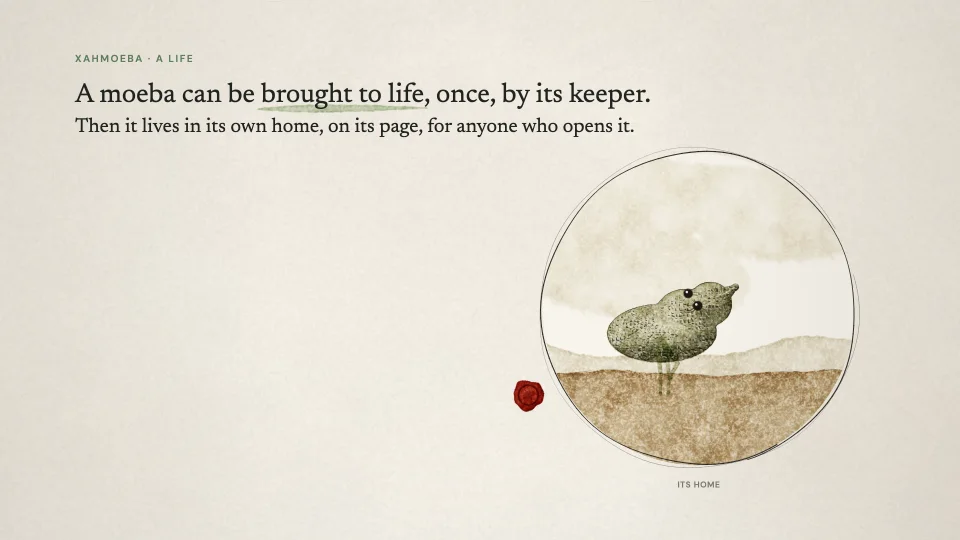
A moeba can be brought to life, once, by its keeper. Then it lives in its own home, on its page, for anyone who opens it.
It has five needs: food, energy, play, company and comfort. They show on its page, and in the way it moves.
Its keeper feeds it, cares for it, plays with it. Each one helps, a little less each time in a row.
Rest is for when its keeper is away. While it rests, nothing changes. Left without food for long, it falls into a long sleep. Its keeper can wake it; its unbroken life starts again.
A home can be opened to visits. A guest stays a while, and both have company.
Each act of care is a transaction its keeper signs. Its life is kept on the ledger, by the LIFE account’s hooks. What it is stays on its token.
A small species, grown from its genome. Bring one to life. Every genome is written on a public ledger.
Feed it, care for it, play, let it rest
One moeba, alive on your device only, in the same home and with the same needs as on a living moeba’s page. Move time on to see what a day, a week or a long absence does. It is a demo: nothing is signed, and nothing reaches the ledger.
Bringing it to life
Its keeper brings it to life once, from its page: one payment to the LIFE account, at a price the account sets and the page shows before you sign, plus a small network fee, under 0.01 XAH. The hooks check that the moeba is of this species and that the payment comes from its keeper, and write its first state: who it is by temperament, its five needs, and when it woke. From then on its page opens onto its home, a world grown from its token, and it lives there for anyone who looks.
Five needs
Food, energy, play, company and comfort drift with time, each at its own pace and each shaped by the moeba’s temperament. Its page says how it is in words — content, a little hungry, bored and wanting to play — and never as a number. How it behaves follows from them: a hungry moeba looks for food, a bored one for something to do, a lonely one for company.
Care
Feed, Care and Play are signed by its keeper, each a transaction with a small network fee, under 0.01 XAH. Food lands near it and it eats; Care is a hand the keeper strokes it with; Play throws a ball onto a spot in its home. Each grows the bond between them, and each can be repeated only after a short while. Touching it, calling it and pointing somewhere for it to go are free and local: nothing is signed, and nothing is written.
Rest, and the long sleep
Rest is for when its keeper is away. It lasts at least 3 days and can’t be ended sooner, by Wake or by a nearer end; it is not a nightly pause. Its keeper rests it until a day they choose, or until they wake it. While it rests its needs, its bond and its unbroken life wait, nothing is lost, and its home is closed to visits. With an end chosen, it wakes by itself.
A long sleep is the loss. Without Feed and without Rest it falls into a long sleep about two weeks after its last Feed, and its page warns of it in the week before. A long sleep ends its unbroken life: its keeper can wake it, for the network fee alone, and it comes back over a couple of sessions, but its unbroken life starts over. It is not death, and it stays in its story.
Your week, and the weeks after
One moeba over eight weeks, under the care pattern you choose, worked out by the same simulator the spec’s numbers were tuned with. Each row is one need: up is content, down is wanting. Hover, or touch, to read a moment as its page would say it.
Visits
A keeper can open their moeba’s home to visits. Another keeper with a living moeba then sees, on that page, “Send … to visit” for a small network fee, under 0.02 XAH, and their moeba arrives in the host’s home for 4 hours, beside up to 3 guests at once. Both pages show the same scene. A guest goes home by itself when its visit ends; it can visit again 12 hours later, and the same host after 24 hours. A moeba that rests is closed to visits.
What is on the ledger, and what is not
On the ledger, in the LIFE account’s entries (rQHGELnuopj4fWjsrbMA53ViqRLt5bS8Hb): each living moeba’s state — its needs, its bond, where it is, when it rests until, how long it has lived and its longest unbroken life, its keepers, how often it was cared for, its visits and its milestones — and, while it hosts, who is visiting until when. Every change is a transaction anyone can read.
Not on the ledger: how it moves, what it does from moment to moment, its voice, where it wanders in its home. Those are worked out on each device from its genome and its state, the same way everywhere. No diary is kept either: its life is counts, lengths and a few dates, not a log of every visit.
One moeba’s state, byte by byte
Paste a living moeba’s token id and read its LifeState straight from the ledger, each field beside the bytes it is written in. This is what its page reads, and all a page needs.
The page reads the ledger itself
A moeba’s page reads its state straight from a public node of Xahau testnet and listens to the LIFE account as transactions are validated, so an action plays on every open page at once, and only once. The site’s index carries a copy of each state to help find moebas, never as an authority. The layout of the state, the hooks and the refusals are on the protocol page.
What to remember
- A moeba is brought to life once, by its keeper, for a price and a network fee. From then on it lives in its own home on its page, for anyone who opens it.
- Five needs drift with time. Feed, Care and Play are signed actions; rest is a pause that loses nothing; a long sleep, about two weeks after the last Feed, ends its unbroken life.
- Its state is on the ledger, in the LIFE account’s entries, and its page reads it there. How it moves is worked out on each device from that state.